Quick answer: A reliable flange manufacturer should prove its capability in forging, heat treatment, CNC machining, drilling, inspection, material traceability, export packing, and documentation. For global buyers, the best China flange factory is not simply the cheapest quotation; it is the supplier that can repeatedly deliver correct dimensions, correct material, and correct paperwork.
How to Evaluate a Flange Manufacturer in China
Searches such as flange manufacturer China, China flange factory, and industrial flange supplier usually bring up many traders and factories. The buyer’s task is to separate sales claims from verifiable manufacturing capability. Ask where forging is performed, where heat treatment is completed, what CNC equipment is used, how drilling is inspected, and whether each finished flange can be traced back to a heat number.
A qualified manufacturer should understand ASME, EN, DIN, JIS, API, and customer drawings. More importantly, the factory should be willing to review the service conditions before accepting a special order. That is especially important for high-pressure, high-temperature, stainless steel, pressure vessel, and oil and gas applications.
Manufacturer Capability by Product Type
| Buyer search term | What to verify | Why it matters |
|---|---|---|
| weld neck flange manufacturer | Hub profile, weld-end preparation, bore matching, NDE option | Controls stress transition and weld fit-up |
| blind flange manufacturer | Thickness, facing, pressure class, material test certificate | Blind flanges carry pressure bending load |
| slip on flange manufacturer | Bore, hub, face finish, bolt hole accuracy, welding instructions | Alignment and gasket seating depend on dimensional control |
| pressure vessel flange manufacturer | Custom drawing review, calculations, NDE, traceability | Pressure boundary parts need higher engineering control |
| ASME flange manufacturer | ASME B16.5/B16.47 dimensional control and marking | Interchangeability depends on standard compliance |
| large diameter flange manufacturer | Machining envelope, flatness control, lifting and packing | Large rings distort and are costly to rework |
Custom Forged Flanges and OEM Stainless Steel Flange Work
A custom flange manufacturer should be able to move from drawing review to material procurement, forging, rough machining, heat treatment, finish machining, drilling, facing, inspection, marking, and packing. Custom does not mean informal. It means the agreed drawing becomes the controlling specification.
Custom forged flanges are often requested for pressure vessel nozzles, replacement equipment, legacy machinery, heat exchangers, offshore packages, and nonstandard pipe transitions. The manufacturer should check feasibility before production: forging size, machining allowance, material availability, tolerances, heat treatment distortion, and testing requirements.
An OEM stainless steel flange project may also require logo marking, private-label packaging, controlled surface finish, passivation, PMI, and recurring batch consistency. For 304 and 316 stainless steel flange orders, confirm grade, low-carbon requirements, surface protection, contamination control, and whether the product-contact environment has special cleanliness requirements.
Large Diameter and High Pressure Flange Manufacturing
A large diameter stainless steel flange or carbon steel ring requires more than a large lathe. Flatness, bolt-hole position, face finish, roundness, weld overlay if applicable, handling marks, and packaging all influence whether the part can be installed without field rework. Large pieces should be inspected with an agreed measurement method and documented before shipment.
A high pressure weld neck flange should receive extra attention to material grade, hub transition, bore, weld-end dimensions, face finish, pressure class, and traceability. In oil and gas or power service, buyers may also require ultrasonic examination, impact testing, hardness testing, PMI, or third-party inspection.
Forged Flange Manufacturer vs Trading Company
A forged flange manufacturer has direct control over forging route, heat treatment, machining, inspection, and schedule. A trading company may still be useful for mixed packages, but the buyer should know who is responsible for quality control and documentation. If a trader quotes the job, ask for the manufacturing site, inspection plan, and document responsibility before placing an order.
For forged flange for oil and gas projects, this distinction matters because missing traceability or incomplete certificates can delay receiving inspection even if the part dimensions look correct.
Stainless Steel Flange Manufacturer Selection
A professional stainless steel flange manufacturer should prevent carbon contamination during handling, machining, and packing. Stainless parts should be protected from carbon steel dust and inappropriate tooling contact. For export, surfaces should be preserved in a way that avoids rust staining during sea freight.
Common choices include 304 stainless steel flange for general stainless service and 316 stainless steel flange where improved resistance to selected chloride environments is required. However, the buyer should not select 316 by habit. Process chemistry, temperature, cleaning method, gasket material, and maintenance practice should all be reviewed.
Documents to Request from a China Flange Factory
- Material test certificate with heat-number traceability
- Dimensional inspection report tied to the purchase specification
- Heat treatment report when applicable
- PMI, hardness, impact, ultrasonic, MT, or PT reports when required
- Marking photos and packing photos before shipment
- Certificate of origin and export packing list for international orders
- Third-party inspection release note when specified
How Songhai Flange Supports OEM and Project Buyers
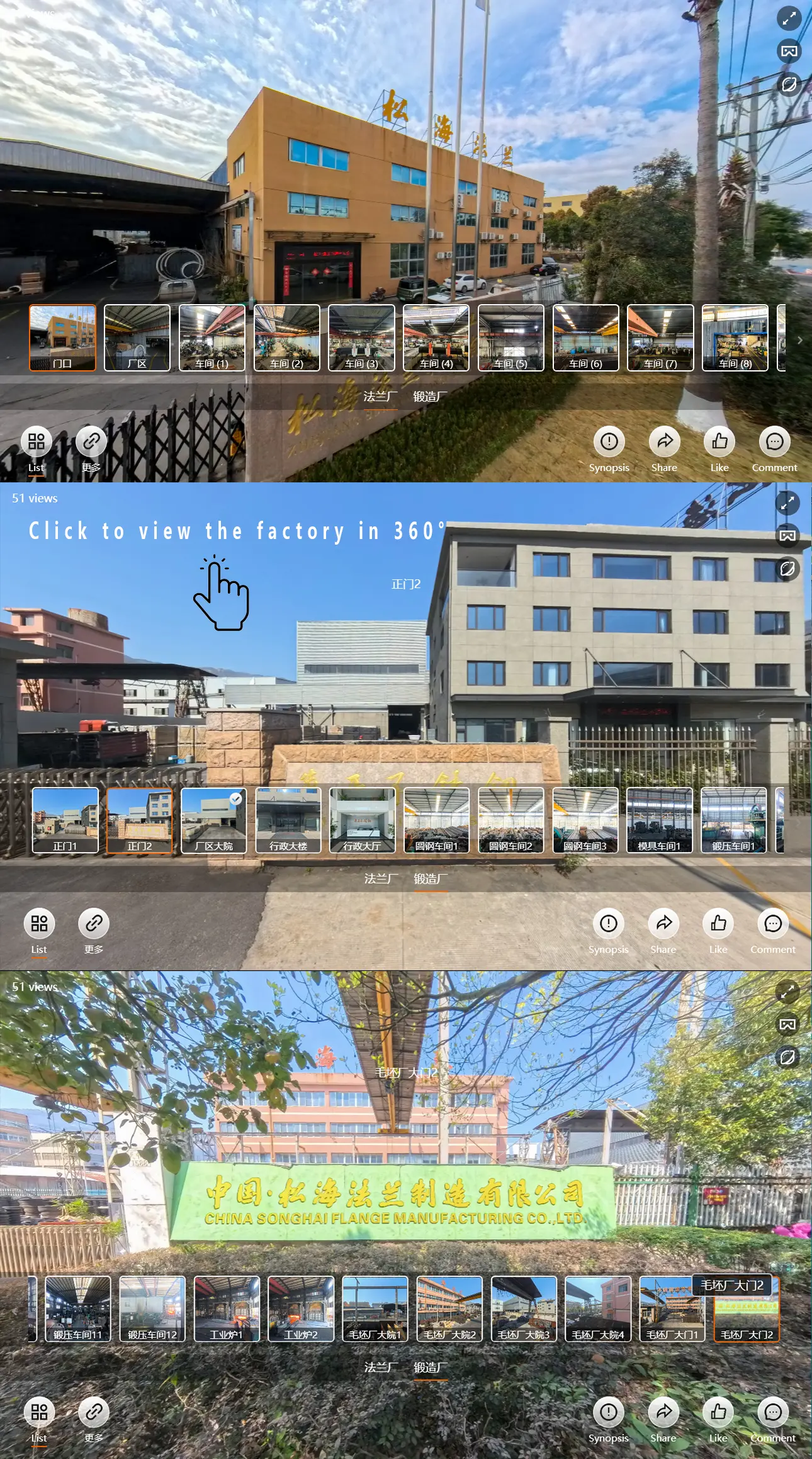
Songhai Flange supports standard and custom flange supply for pressure vessel, chemical equipment, oil and gas, petrochemical, power generation, marine, and general industrial piping projects. Buyers can request weld neck, blind, slip-on, threaded, socket weld, lap joint, plate, forged, stainless, carbon steel, alloy steel, and large-diameter flanges according to recognized standards or approved drawings.
For a fast technical quotation, send the standard, size, pressure class or PN rating, material, flange type, facing, bore, drawing, quantity, inspection requirements, certificate requirements, destination, and Incoterm. Clear input prevents delays and helps the manufacturer quote the real scope rather than a generic part number.
FAQ
What is the difference between a flange supplier and flange manufacturer?
A supplier may stock, trade, package, or distribute flanges. A manufacturer controls production steps such as forging, machining, drilling, facing, inspection, and marking.
Can a China flange factory supply OEM packaging?
Yes, many projects can use OEM marking or packaging when drawings, branding rules, compliance requirements, and minimum order details are agreed before production.
How should buyers compare flange quotations?
Compare the same standard, material, size, class, face, quantity, test requirements, document requirements, packing, Incoterm, and lead time. A cheaper quote with missing documentation is not a true equivalent.WhatsApp: +86-18658777855
E-Mail: 1007788887@qq.com
Das könnte Sie auch interessieren
DIN Flanges vs ANSI Flange: ANSI Class 150, PN Rating and Selection Guide
A practical guide comparing DIN flanges and ANSI flange standards, including ANSI Class 150, PN meaning, flange rating ANSI systems, bolt patterns, dimensions and selection tips.
Flange Coupling Guide: Coupling Flange Type, Flanged Coupler and Shaft Applications
A practical guide to flange coupling, coupling flange type selection, flanged coupler structure, flange shaft coupling applications, installation and maintenance.
What Is an Orifice Flange? Orifice in Piping, Orifice Pipe and Flow Measurement Guide
A practical guide explaining what an orifice flange is, how an orifice in piping works, orifice pipe flow measurement, pressure taps, orifice plates and selection tips.